


Articles
Stances in Taekwondo
One of the most important aspects of martial arts training, whether it is in taekwondo or any other style, is footwork. If your footwork is not good, then you need to work on it. No successful martial artist ever considered footwork to be unimportant.
Imagine, for a moment, cannon on board a ship or defending the ramparts of a castle. When a cannonball is fired, there is a reaction from the explosion in the gunpowder. This reaction causes the cannonball to shoot out, but also forces the cannon to move backwards if it is not securely fixed into place.
This is one of the principles upon which taekwondo stances are based. If you fire out your fist like a cannonball, you have released a good punch. But if your feet slip back, some energy is wasted. This is not good because part of what you are trying to achieve in taekwondo is focusing all of your energy into a single point.
Now imagine that you actually hit some-thing. This time, the reaction will be even stronger because the impact reflects back-wards through your body as reaction force. If the reaction force knocks you off balance or throws you back, you will probably be in worse trouble than you were before the punch!
The solution to this is to use a good, strong stance that can withstand the impact of the reaction to your techniques. The stances in taekwondo are similar to those in most martial arts. For example, the front stance in taekwondo is also used in other Martial arts, such as judo and karate. Chinese and Korean styles tend towards slightly shorter stances, for reasons of their own, although this is not a hard-and-fast rule.
The next thing to be concerned with after your stance is how to move in that stance. If you are rooted to the spot, you will not be much of a martial artist ! When stepping, the physics are designed to try to maintain the integrity of the stance. This means that you should be well balanced when making transitions between your stances.
Your stepping and stances are also the key to your distancing. If you are good with your footwork, it is possible to throw a person off balance just by stepping towards them in the correct way. Clearly, correct footwork is an aspect of the art that will be refined throughout your progress in taekwondo. How you understand your footwork in a year's time should be different to your current comprehension.
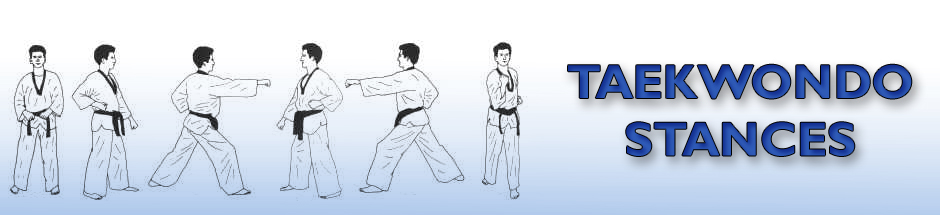
The Stances
Ready Stance: The ready stance is the one that you use at the beginning of all of the poomse and other formal exercises. Your body should be straight and well aligned. This shows that you have strong spirit. Stay alert when in the stance. The ready stance is a neutral stance that is neither aggressive nor retreating. Your feet should be a hip-width apart.
Front Stance: Front stance is a strong attacking stance that can also be used for blocks. The power of the stance is in pushing your energy and strength forwards. Your weight should be split approximately 70/30 between your legs, with 70 per cent on your front leg. The stance should be the width of your shoulders and one-and-a-half shoulder-widths in length. Your front leg should be bent at the Knee and your back leg should be straight. Your hips should face forwards. Both feet should stay flat on the floor. Your rear foot should be at an angle of around 45 degrees.
Back Stance: Back stance as you can probably work out from your newly gleaned knowledge of the front stance, the back stance is primarily a defensive stance that can also be used for attacking. In this stance, the weight split is still 70/30, but in reverse. Your back leg carries most of the weight. Your heels should be in line with each other. Again, the front foot is straight and the back foot is positioned at an angle.
Riding Stance: Riding Stance a sometimes called the horse-riding stance. The idea is that you should look like you are riding a horse. The inner edges of your feet should be parallel and about two shoulder-widths apart. You need to sink down on to your knees, so your knees will be turned outwards slightly, your weight should be equally distributed between your feet. This stance is very useful for sideways attacks, such as the side-snapping kick. It can also be used as a stable base for a front attack if you want to deliver a powerful punch.
Fighting Stance: Not strictly an "official" stance, but it one that you will use for fighting and sparring.